The Hereford AVBCW Blog (TNG) now contains all the details for the forthcoming SPRING BIG GAME 2019, to be held at the Burley Gate Village Hall, Herefordshire, on Saturday 23rd March 2019 from 10am to 5pm. Head on over to get all the background and arrangements, starting from HERE. News, too, of foreign parts : all the latest from Captain Wilfie Smith and The Forest of Dean AVBCW can be found HERE !!
Sunday, 24 February 2019

Thursday, 17 January 2019
Pacifism (1) - The Peace Pledge Union and the VBCW
There was a significant pacifist movement in 1930's Britain, driven by the horrors and losses of the First World War and the fear that such might be repeated. In 1934, the Rev. Dick Shepherd, Canon of St. Paul's Cathedral, published a letter in the "Manchester Guardian" and other newspapers, inviting men (but not women, curiously) to send postcards to him pledging never to support war. Out of this initiative - for 135,000 men responded to the Canon's call - emerged the "Peace Pledge Union", which by 1936 had opened its ranks to women and was publishing a weekly newspaper, "Peace News". The Peace Pledge Union attracted a wide variety of members, including Christian pacifists, socialists, anarchists and in the words of a PPU member, Derek Savage, "an amorphous mass of ordinary well-meaning but fluffy peace-lovers". In 1937, the Peace Pledge Union merged with the No More War Movement, and George Lansbury, the Chairman of the NMW and former Leader of the Labour Party (and of the Opposition), became President of the PPU. As Labour leader, Lansbury had adopted a position of Christian pacifism, unilateral disarmament and the dismantling of the British Empire, publicly stating in late 1933: "I would close every recruiting station, disband the Army and disarm the Air Force. I would abolish the whole dreadful equipment of war and say to the world : 'Do your worst'". In the "alternative timeline" (of reality), the PPU opposed the Second World War and argued for a negotiated peace with Germany. PPU membership reached a peak of around 140,000 in 1940. In contrast, it seems that membership of the BUF peaked in 1934 at 40,000 (and arguably declined to about 9,000 by 1940) and that the Communist Party of Great Britain had only 17,756 members in July 1939. [note1]
 |
| Canon Dick Shepphard preaching |
 |
| Rt.Hon. George Lansbury MP Leader of the Labour Party and Opposition 1932-1935 |
 |
| The Canon advertising a Peace Pledge Union meeting (or "Mass Protest") at which he and George Lansbury will be the principal speakers in favour of the controversial(?) proposal "War - We Say No!" |
Given the strong pacifist tendencies of Britain during the 1930s, together with Edward VIII's decision to refuse the prospect of Abdication, dismiss his Government and co-operate with Mosley's BUF, the first issue for VBCW gamers is: what would the PPU have done, not in fear of a general European war and repeat of WW1, but in the face of a Very British Civil War? [note2]
Note1: see the article by Andrew Thorpe of the University of Exeter HERE
Note2: a partial but immediate answer to this issue may perhaps be gleaned from Canon Dick Shepphard's 1931 proposal in response to the Sino-Japanese War, namely that a "Peace Army" of unarmed peacemakers should stand between the Chinese and Japanese armies in Shanghai.
Wednesday, 16 January 2019
Herefordshire Lord Lieutenants and High Sheriffs (Part One)
Lord Lieutenants of Herefordshire 1660 - 1960
30 July 1660 – 22 March 1689 Henry Somerset, 1st Duke of Beaufort
22 March 1689 – 31 May 1694 Charles Gerard, 1st Earl of Macclesfield
31 May 1694 – 15 June 1704 Charles Talbot, 1st Duke of Shrewsbury
15 June 1704 – 18 November 1714 Henry Grey, 1st Duke of Kent
18 November 1714 – 11 September 1721 Thomas Coningsby, 1st Earl Coningsby
11 September 1721 – 16 July 1741 James Brydges, 1st Duke of Chandos
16 July 1741 – 5 June 1747 Charles Hanbury Williams
5 June 1747 – 2 March 1802 John Bateman, 2nd Viscount Bateman
20 March 1802 – 28 October 1817 George Capell-Coningsby, 5th Earl of Essex
28 October 1817 – 5 January 1841 John Somers Cocks, 1st Earl Somers
29 January 1841 – 22 July 1845 William Bateman, 1st Baron Bateman
6 August 1845 – 5 October 1852 John Somers Somers-Cocks 2nd Earl Somers
11 November 1852 – 30 November 1901 William Bateman Bateman-Hanbury,
2nd Baron Bateman
2nd Baron Bateman
27 January 1902 – 5 December 1904 John Hungerford Arkwright
5 December 1904 – 27 July 1933 Sir John Cotterell, 4th Baronet
27 July 1933 – 14 July 1944 Arthur Somers-Cocks, 6th Baron Somers
28 February 1945 – 12 July 1957 Sir Richard Cotterell, 5th Baronet
9 September 1957 – 13 July 1960 James Thomas, 1st Viscount Clicennin
(Note : there were only 18 Lord Lieutenants in 300 years)
High Sheriffs of Herefordshire, 1900 - 1960
Pre-WW1
1900 : John Wood, Ivington, Leominster
1901 : James Louis Alexander Hope, Whitney Court, Whitney
1902 : George William Marshall, Sarnesfield Court, Weobley
1903 : Sir Joseph Verdin, Bt. Garnstone Castle, Weobley
1904 : William Theodore Barneby, Saltmarshe Castle, Bromyard
1905 : Roger Charlton Parr, Stanton Park, Stanton-on-Arrow
1906 : Paul Henry Foley, Stoke Edith Park, Hereford
1907 : Charles James Paul Gwyer, Eywood, Kington
1908 : Thomas Davies Burlton, Eaton Hall, Leominster
1909 : Ralph Tichborne Hinckes, Foxley, Hereford
1910 : Captain Evans Mynde Allen, Manor House, Upton Bishop, Ross
1911 : Sir Herbert Archer Croft, Bt. Lugwardine Court, Hereford
1912 : Charles Thornton Pulley, Lower Eaton, Hereford
1913 : Sir Geoffrey Cornewall, Moccas Court, Hereford
1914 : George Ernest Wright, Puddlestone Court, Hereford
WW1
1915 : Lennox Bertram Lee, How Caple Court, Hereford
1916 : James Tudor Hereford, Sufton Court, Mordiford, Mordiford
1917 : Col John Dutton Hopton, Ledbury
1918 : Sir Richard Harington, Whitbourne Court, Worcester
Post WW1
1919 : Guy Rawson Trafford, Hill Court, Ross
1920 : Col Gilbert Charles Bourne, Cowarne Court, Ledbury
1921 : Col Peter Legh Clowes, CB, Burton Court, Eardisland
1922 : Lt-Col Edward Marten Dunne, Gatley Park, Kingsland
1923 : Capt. Laurence Nugent Hope, Whitney Court, Whitney
1924 : Major Stewart Robinson, The Ovals, Kington
1925 : Capt. Lionel Havercroft Green, MBE, The Whittern, Lyonshall
1926 : Charles Andrew Rouse Broughton-Knight, Downton Castle, Downton
1927 : Major George William Davey, Kinnersley Castle, Eardisley
1928 : Captain John Ralph Henry Harley, Brampton Bryan
1929 : Lt-Col. George Basil Heywood, Caradoc Court
1930 : Charles Anthony Benn, Moor Court, Kington
1931 : Col. Henry Evan Pateshall Pateshall DSO, Allensmore Court, Hereford
1932 : Herbert Ronald Pettit, Castle Weir, Lyonshall
1933 : Major Charles Jerome Vaughan, Courtfield, Ross
1934 : Mr E.F. Bulmer, "Adams Hill" Breinton, Hereford
1935 : H.R. Jenkins, The Porch House, Westhide, Hereford
1936 : George Malcolm Kent, Garden House, Shobdon
"The VBCW ?"
1937 : The Rev. William Marshall, Sarnesfield Court, Hereford
1938 : Robert Holme Storey, Bishopswood, Ross on Wye
1939 : Lt-Gen Sir George Sidney Clive GCVO, KCB, CMG, DSO Perrystone Court, How Caple
WW2
1940 : Henry Howard Bulmer, Longmeadow, Hereford
1941 : Eric Carnegie Romilly, Broadfield Court, Bodenham, Hereford
1942 : Thomas Henry Foster, The Grange, Whitchurch
1943 : Major Owen George Scudamore Croft, Hephill, Lugwardine
1944 : Richard Saher de Quincy Quincy, The Vern, Bodenham
1945 : Vice-Admiral Frederick Parland Loder-Symonds, Waldrist, Ayleston Hill, Hereford
Post WW2
1946 : Colonel Cecil John Herbert Spence Colby, Donnington Hall, Ledbury
1947 : Major Henry Thomas Hamilton Foley MBE, Stoke Edith Park
1948 : Captain Edward Francis Herbert Evans, Whitbourne Hall, Herefordshire
1949 : Major John Lewes Davenport, Yarsop House, Mansel Lacey
1950 : Gerard Leigh Clay, Brockhampton Cottage
1951 : John Francis Maclean, Thatch Close, LLangrove, Ross
1952 : Thomas Philip Barneby, Saltmarsh Castle, Bromyard
1953 : Brig. Gen. TRF Bats, Glenmonnow House, Garway
1954 : Brig. FAV Copland Griffiths, Bircher Hall, Leominster
1955 : Sir Frederick Burrows, Thrushes Nest, 37 Rope Walk, Ross on Wye
1956 : Henry Maysey Barneby, Brockington House, Bredenbury
1957 : Herbert Roy Rowlands, Brand Lodge, Colwall
1958 : Brigadier Robert Peel Walker DSO MC Wyastone Leys, Monmouth
1959 : Lt-Col JA Hill OBE, Orleton Manor Court, near Ludlow
1960 : Thomas John Hawkins OBE, Wilton Oaks, Tarrington
(Note: as set out above, the office of Sheriff was an annual office only)
(Note: as set out above, the office of Sheriff was an annual office only)
Tuesday, 8 January 2019
AUTUMN BIG GAME 2018 (PART FOUR - CONCLUSION)
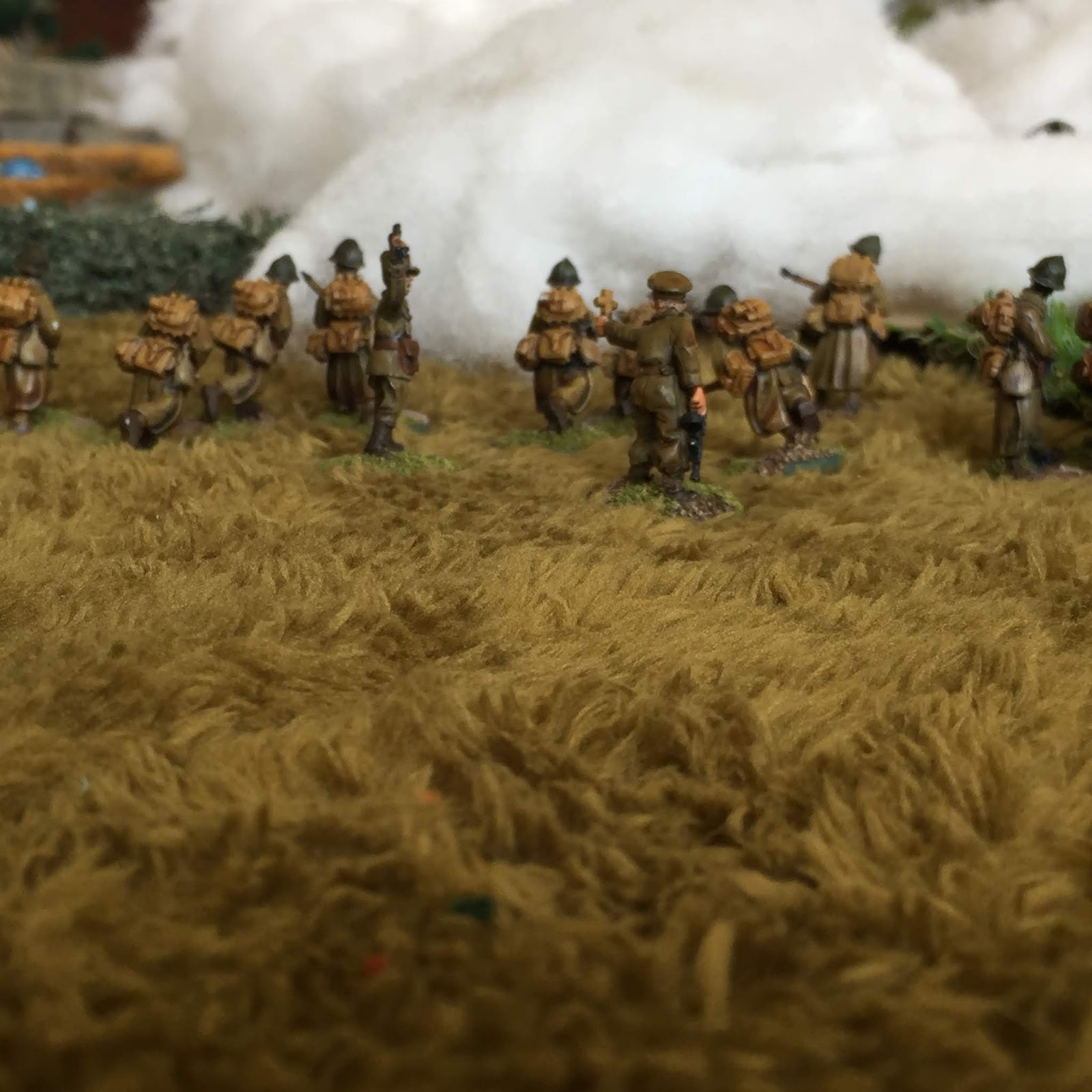 |
| "Our Brave Boys Go In" As Lt. Everard struggles on the left and centre, the Ludlow Expeditionary Force launch their flank attack on the right. A crucifix waving Chaplain provides critical moral support as 3rd Section, LEF, charge into the smoke. |
 |
| "The Bear at Bay". Commandant Joubert has now taken refuge in "Stokkies House", taking frenzied potshots at the remaining elements of the Golden Valley Invincibles (top left) and screaming for his long awaited reinforcements to arrive. In the gardens to the right, the First Section of the Kings Colonials, still shrouded in smoke, somehow contrive to repluse two charges from the flanking (and far more numerous) LEF, but then begin to fall steadily as the LEF draw off, curse the "ridiculous charge rules" and resort to heavy and accurate gunfire. |
 |
| "The Reinforcements Now Arrive" At last the D6 smiles upon Stokkies. Two full sections of the Kings Colonials arrive, seemingly in the nick of time. The depleted First Section, KCol, withdraw from the gardens of "Stokkies House" under cover of an HMG. Just visible against the rear wall of the house, Stokkies AT Gun is being desperately manhandled towards the centre of the battlefield and the marauding Vickers Mk.VI. |
 |
| "The Queen of the Battlefield" Anglican spotters detect the arrival of Stokkies' reinforcements, and the Ludlow artillery roars into action, firing carefully hoarded long range shells. The barrage (assisted by lucky activation cards) is devestating...... |
 |
| "The Results of Accurate Fire"......as Stokkies' re-inforcements are "pulped" and "mashed" and generally thrown about by the incoming shells. Their morale plummets, becoming "Jumpy" - or worse - and unable to move.. |
 |
| "An Isolated Commander"....leaving Commandant Stokkies and his batman completely isolated. A special "snatch squad" of Ludlow veterans close assault "Stokkies House" as his reinforcements look on, helpless. The batman falls. Firing two handed and screaming defiance, Stokkies takes on an entire LEF Section himself, killing two. But the odds are too great, even for the South African legend... |
 |
| "Take him to the Bishop!"....a bruised Stokkies Jourbert is lead away into captivity. Learning of his fellow commander's fate, and hard pressed both in the centre and on the left, Lt. Everard decides to "live free and fight another day", slowly disengaging his forces from those of the exhausted victors, and retreats in the direction of Hereford. He quickly scribbles some despatches to Lord de Braose, a copy of which subsequently fell into Anglican hands The Battle of Winforton Pontoons is finally over. |
AUTUMN BIG GAME 2018 - THE TRUE STORY (PART THREE)
 |
| "The Climax of the Battle" As the Anglican Tank Brigade debouch from Sir Gilbert's completed pontoon bridge, Lt. Everard concentrates his forces to meet the threat. Naval crewed Tank Destroyers (a reinforcement) hurry into action, only for one of them to be "brewed up" immediately. The BUF's Heavy Artillery ("The Dominator") roars its continued defiance, as Lt Everard swings his left flank tanks towards the west and the advancing Anglican armour. |
 |
| "The Ace of Spades" A close up shot of the same incident. The Anglican armour leaves its "Death Card" (the Ace of Spades) as one of HMG's Naval Tank Destroyers blows up spectacularly. (GRRRR...who left those activation cards on the table!) |
 |
| "Pastor Head's Assault" With the BUF armour diverted towards the centre of the battlefield, Pastor Head's forces launch their long delayed infantry assault on the eastern flank. A decimated Wulfhere Section, BUF, contest the fenceline : in the nick of time, the Wormelow Wildcats (a reinforcement) arrive in support. |
 |
| "The Golden Valley Womens Institute" The Anglicans advance all along the line. Here Sir Gilbert's last reserve, the Women's Institute, charge into the fray in the centre. Behind them, in a fine example of inter allied co-operation, Ludlow tanks debouch from Sir Gilbert's pontoon bridge. To the left, it appears that the Anglican artillery are now firing non explosive tape measures (GRRRR!) |
 |
| "Down, Rover!" The Women's Institute are met by a charge of ravenous, mouth foaming BUF attack dogs, and recoil. Support for the RSPCA will be first item on the agenda of their next meeting in Pontrilas. |
 |
| "The Centre cannot Hold?" HMG extracts revenge for its lost Tank Destroyer, "brewing up" an Anglican tank in return (left). Sir Gilbert's Steam Tank ploughs on, supported by two Ludlow tanks. On the right, an Anglican Vickers Mk.VI embarks on a "general swan about" the battlefield, ready to threaten the remaining HMG infantry. Lt Everard's valiant efforts can surely only delay the inevitable... |
AUTUMN BIG GAME 2018 - THE TRUE STORY! (PART TWO)
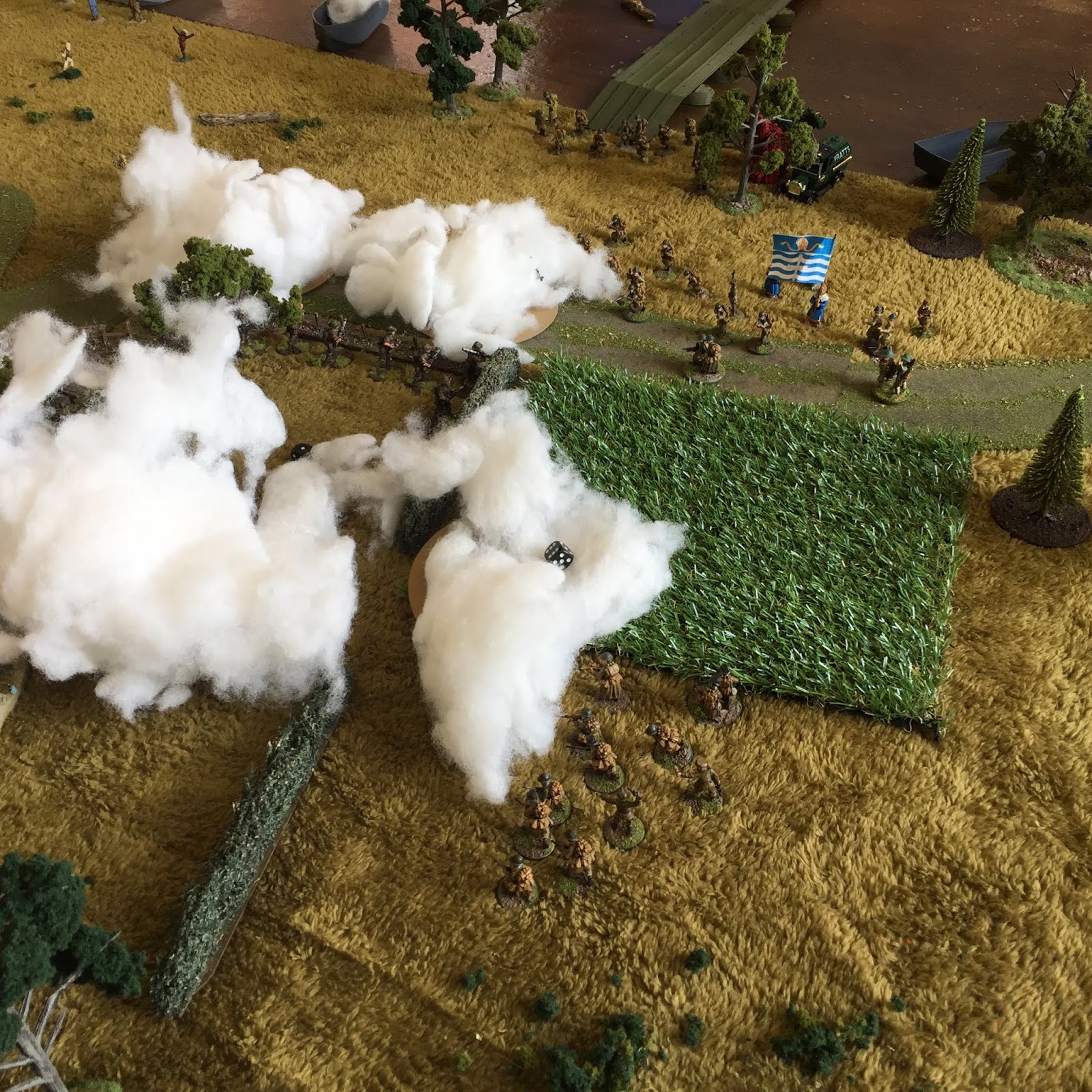 |
| "A Flank Attack in Preparation". 3rd Section, Loyal Ludlow Infantry, have worked their way around Stokkies' flank. 2nd Section (with Standard) take advantage of a continuing smoke barrage. 1st Section advances from the now complete Pontoon Bridge. Where are Stokkies reinforcements? |
 |
| "The Courageous Self Sacrifice of the Invincibles". Sir Gilbert's men (and women) advance on a very broad front, drawing fire from both Stokkies troops and those of Lt. Everard. It was the Invincibles' willingness to take huge casualties that enabled the Allied victory. |
 |
| "Technical difficulties" On the right flank, spooked not by fire but by a sudden storm of thunder and lightning (chance card event), Pastor Head's engineers are too jumpy to finish building their Pontoon Bridge. A Ludlow tank waits in vain. It could only be the VBCW. |
 |
| "The Tank Brigade will Advance!" Sir Gilbert's engineers complete the central Pontoon Bridge, and Pastor Head diverts the Anglican Tank Brigade across it. For HMG, matters are now looking blacker than a BUF uniform (at midnight).
TO BE CONTINUED......
|
Monday, 7 January 2019
AUTUMN BIG GAME 2018 - THE TRUE STORY! (PART ONE)
"And so, Commandant Joubert, we meet at last."
The Bishop of Ludlow stared at his bruised and manacled prisoner, surrounded by the triumphant veterans of the 1st Infantry Section, Loyal Ludlow Legion. It was late on the afternoon of the Battle of Winforton Pontoons, and all the reports spoke of a famous victory for the allied forces of the Anglican League and Sir Gilbert Hill's Golden Valley Invincibles.
"Joubert. Stokkies. I don't have a number. I'm not a regular. I fight for my King as a loyal volunteer." The captured commander of the famous "King's Colonials" stared back at the Bishop, uncowed. "And you'll get no more information out of me, dwankie. Geneva Convention."
"Dear, dear. 'My Lord Bishop' is more - ahem - conventional, dear chap." The Bishop of Ludlow smiled thinly. "You ought to know that I served in South Africa for a time. Enough time to pick up a smattering of Afrikaans slang [note 1]. And as for the Geneva Convention, I rather think it has no application to a civil war. At least, that's what I understand your Mr Mosley to have claimed."
"The Prime Minister....."
"An office to which he has no entitlement. Just plain Mr Mosley, if you please."
"Fok weet, Bishop. I'm a colonial. Ein Jan Allerman. You'll get nothing more out of me."
"I rather think we will, Commandant." A severe, straight backed figure materialised at the Bishop's shoulder. It was none other than "Big X", Chief of the Ecclesiastical Intelligence Service. "Not that we particularly need to, of course."
"Ah, Lethbridge-Stewart. I see you have one of your manilla folders on this ruffian." Still slightly unsettled by the Colonel's habit of appearing silently and without warning, the Bishop sniffed and nodded in approval.
"Joubert, Stokkies." The Colonel began reading. "Great - nephew of Piet Joubert, late of Cape Colony...."
"The South African Republic, krimpie. Ne?"
"...and necessarily, therefore, a relation of Fritz Joubert Duquesne. We have rather a thick file on him, of course. Not that you've met for a while. Not since New York, I believe." The Colonel cleared his throat, flicking through the file. "Stokkies.....war service...volunteering slightly under age, I think....German South-West Africa, East Africa, junior ADC to Smuts....some special service for a period...1919 intervention, Murmansk....demobilisation....diamond mining...gold panning....great white hunter in Kenya, then gun running to South America....whisky smuggling into the States from 1928 or so....the Twenty-First Amendment must have been so disappointing for you, Commandant...back to South Africa....heavy drinking...the women (see additional filing cabinets, as indexed A-Z, cross-referenced geographically, ethnically and chronologically)....do I need to go on?"
"Fokkoff, moffie." The manacled Commandant bristled.
"Now, now, Commandant." The Bishop of Ludlow intervened. "The good Colonel is simply demonstrating that we already know all about you. It's just that he believes you privy to all of Lord de Braose's most secret plans, and we'd rather like to hear about them, don't you know? Not that we have anything like an Inquisition in Ludlow, you understand. None of that foreign stuff. No Iron Maidens, racks, red-hot pokers; no, I do believe that the Colonel's methods of extracting information are rather more subtle..."
"Joubert, Stokkies. No number. No more information."
"Of course it pains me, Commandant. But you may think differently after a few days of compulsory crocheting".
"Nee!" The stubborn Joubert staggered backward in shock.
"Just the threat of solitary confinement and enforced embroidery...."
"Nee!" Joubert had involuntarily collapsed to his knees, a bear of a man at bay.
"Jam-making? The full course of 26 lessons, all the while on a strict prison diet of nothing but ginger beer and iced fruit cakes? No braii for you, ever again....."
Joubert sagged lower, as if physically winded. Colonel Lethbridge Stewart took up the Bishop's theme enthusiastically.
"Four church services a day. Marched backwards and forwards to service and then your cell, deep beneath Ludlow Castle. Hymns, prayers, sermons, choir practice, silent personal contemplation, 'Signs of the Peace'...."
"Sies!"
"....and if you should somehow still resist, Commandant, the genteel horror that is Mandatory Morris Dancing. I'm told the local Morris troupes are always looking for new members, and are really rather dedicated..."
A sudden howl of utter despair, as Joubert contemplated his awful future as an unwilling be-belled participant in "(Very) Strictly Come Dancing - the Folk Edition", and with the interview over, the veterans of the Loyal Ludlow Legion dragged him from the Bishop's presence.
How had it come to this ?
The "Hurrah for Victory!" special edition of the "Illustrated Ludlow News" explained all to its joyful readership:
 |
| "Commandant Stokkies Joubert at the start of the Battle". The Kings Colonials Commander surveys the ground from a wheatfield, his HQ Section supported by a Vickers Machine Gun. He is not to know that, before the end of the day, he will be unwillingly introduced to "compulsory crocheting". |
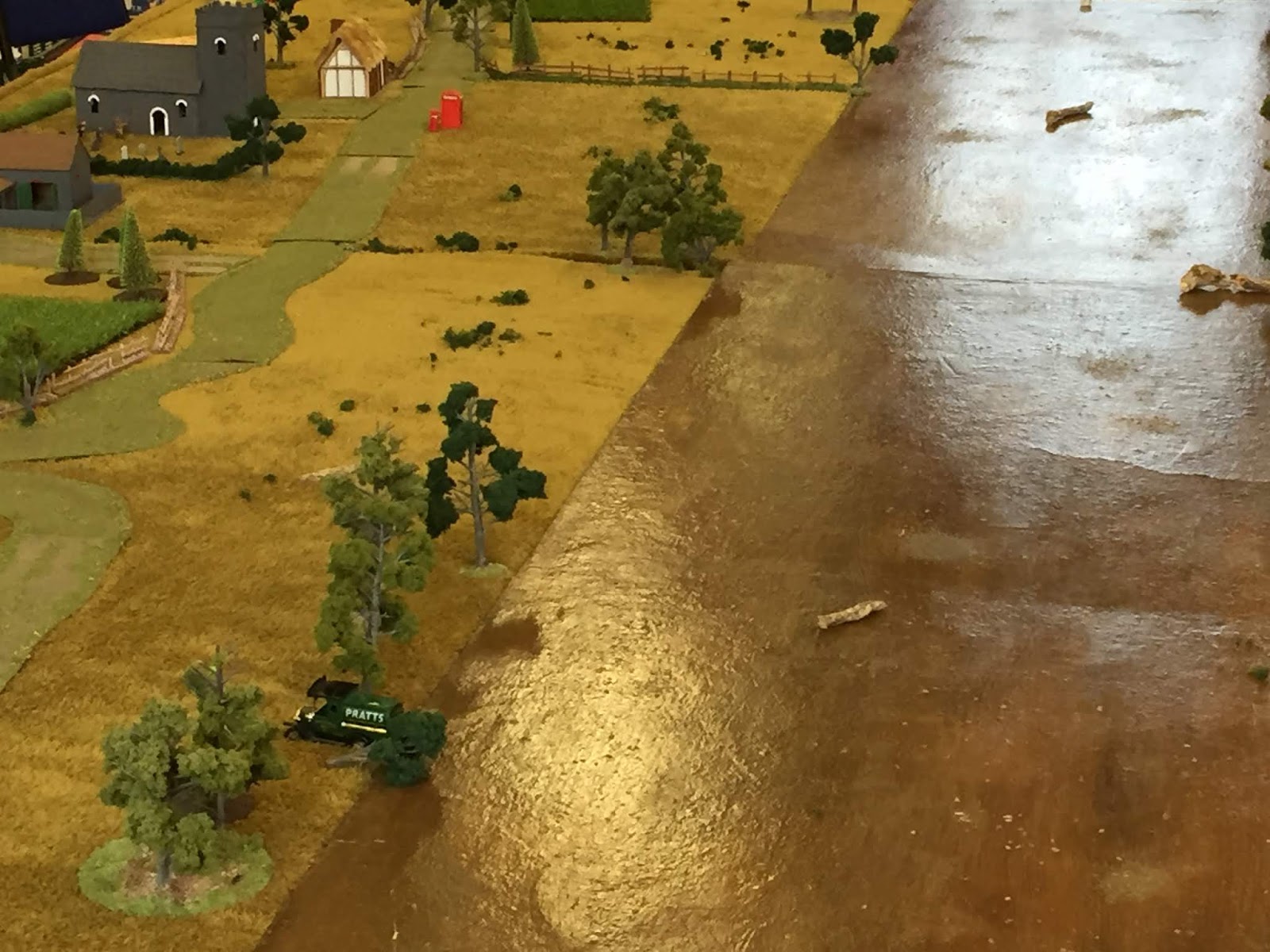 |
| "The River Wye in spate - a substantial battlefield obstacle". A suspicious civilian fuel tanker commandeered from Pratts Garage in Winforton has been parked (rather too obviously) close to the water's edge. |
 |
| "Allied Forces prepare for a contested crossing" The Bishop of Ludlow's forces (nearest camera, with well known command flag) start moving their assault boats forwards. The Loyal Ludlow Artillery unlimber. Sir Gilbert's Golden Valley Invincibles (centre of camera, with mostly numbered assault boats) equally advance. To the right of Sir Gilbert (out of shot), Pastor I.S. Head's Anglican Force similarly heads for the river's edge. A general attack along the Wye! |
 |
| "Smoke, boys, smoke! Pour it on!" Sir Gilbert's special battery of smoke shell firing tanks commence fire. The wind direction (south to north) provided a substantial advantage to the attacking allies, and did not veer throughout the battle (notwithstanding D6 die rolls - EM-4 direction die (other brands are available)). |
 |
| "A cunning ploy unmasked" Correctly anticipating a trap, the Ludlow Loyal Artillery blow up the Pratts tanker. A flaming oil slick spills into the River Wye anyway, just as HMG originally planned. Will it interfere with Ludlow's contested crossing of the Wye? |
 |
| "Our Brave Engineers start a Pontoon" Undeterred by the flaming oil slick, work commences on the Ludlow Pontoon Bridge. Downriver, Sir Gilbert and Pastor Head were equally busy constructing their own pontoons. In the background, Ludlow artillery, armoured observation vehicle and observation party. |
 |
| "Assault Boats Ahoy!". A fleet of small grey boats fills the River Wye. To the bottom of the photograph, the Bishop's forces steer carefully to avoid the oil slick. Pontoon bridge building is interrupted. In the centre, Sir Gilbert's pontoon is making progress, although one of his assault boats has fallen prey to counter-battery fire. At the top, Pastor Head similarly pushes forward by boat and pontoon. |
 |
| "The Battlefield from the East" A different view of the Allied dispositions, taken slightly earlier in the day. Pastor Head's assault boats are at the water's edge (bottom of photo). Sir Gilbert's smoke tank battery (top centre left) lay down their first barrage as the Golden Valley Invicibles prepare their boats (centre). On the road (left, centre/top) can be seen the massing Anglican Tank Brigade, ready and waiting for a Pontoon Bridge to be satisfactorily erected. The Bishop's forces are at the very top of the photo, beyond the smoke tank battery. |
 |
| "But 30 minutes later - mayhem" An aerial shot as Sir Gilbert's and Pastor Head's forces cross the Wye under fire and under cover of a smoke barrage. Their pontoons are being prepared for the Anglican Tank Brigade. The Bishop's forces are out of shot at the bottom. |
 |
| "Defenders' Positions" A long shot of the north bank of the Wye. In the bottom right hand corner lies "Stokkies House", where the Commandant established his permanent HQ during the battle. The King's Colonials artillery battery and observers can be seen in the green field to the left of "Stokkies House". The area to the left again, covering the farm buildings and Winforton church, came under the command of the newly arrived Lieutenant Richard Everard. At the very top, by the church, a BUF Heavy Gun rolls into place. HMG Forces await re-inforcements eagerly.... |
 |
| "The Dominator" A closer shot of the BUF Heavy Gun next to Winforton Church. |
 |
| "A gift from Signor Mussolini" Hard by the farm buildings, another Government artillery piece opens up on the advancing Allies. |
 |
| "Winforton Church through the Smoke Barrage" A view from the south bank of the Wye, the tower of Winforton Church (top centre) appearing through the smoke. Pastor Head's and Sir Gilbert's pontoons can both be seen as the Anglican Assault boats hit the north bank of the river. To the left, Ludlow tanks lead the waiting Anglican Tank Brigade. |
 |
| "Ashore at last" A panoramic shot as Sir Gilbert's Golden Valley Invincibles swarm off their assault boats on to the north bank of the Wye. The prevailing winds (attributed by the Bishop of Ludlow to divine intervention) push the prevailing smoke helpfully forward.... |
 |
| "The gallant Pastor Head". On Sir Gilbert's right flank, Pastor Head's Anglican forces advance from their beachhead. In the distance, Lt. Everard positions in opposition part of the BUF Tank Brigade (a reinforcement) and the Wulfhere Section, BUF (along the fence line). These tanks were to vex the lightly armed forces of Pastor Head mightily, causing him to pray for the completion of his Pontoon and re-inforcement from the Anglican Tank Brigade as soon as possible. |
 |
| "Forward Ludlow!" On Sir Gilbert's left flank, the Ludlow Expeditionary Force storm ashore. The Bishop's personal standard can be seen (right) as further smoke shells fall amongst the advance piquets of the embattled King's Colonials (left, top)
TO BE CONTINUED BY PART TWO.......
[Note One] To those less familiar with Afrikaans slang than the good Bishop, this information page may help (and provide some fun).
|
Subscribe to:
Posts (Atom)